Curated by Schleuse, Vienna
Opening: Saturday, 25 October 2025, 6–9pm
25 October – 13 December 2025
Visits by appointment and as announced on our Instagram account.
Two converging notions of space are proposed by Anna Holtz and Kathrin Wojtowicz in their exhibition Areal, the Berlin sequel to an exchange between Stations and Schleuse that began a year ago in Vienna with the exhibition of Seda Mimaroğlu and Raluca Popa. The title, the German word for “area”, hints at this.
The first notion takes as its premise the locality of the artistic act, which not only frames the work but actively shapes it as well as the thinking related to it. In Anna Holtz’ case, this is expressed through a historic and psychogeographic investigation of the area around Kottbusser Tor, with particular attention to the Neues Kreuzberger Zentrum (NKZ) – the building complex that houses Stations, among many others. Built as social housing between 1969 and 1974 during a period of structural demographic shifts in the neighbourhood, and following numerous debates and protests, the complex was part of a modernizing city-planning initiative and was initially financed by private investors incentivized by a tax-saving law. The project proved to be an unsuccessful financial venture, facing delays, repeated changes to the building plans, and a rushed construction process, which soon led to infrastructural problems whose documentation is insufficient, as are the potential
solutions, leaving its current tenants in a bureaucratic, but also psychological, limbo.
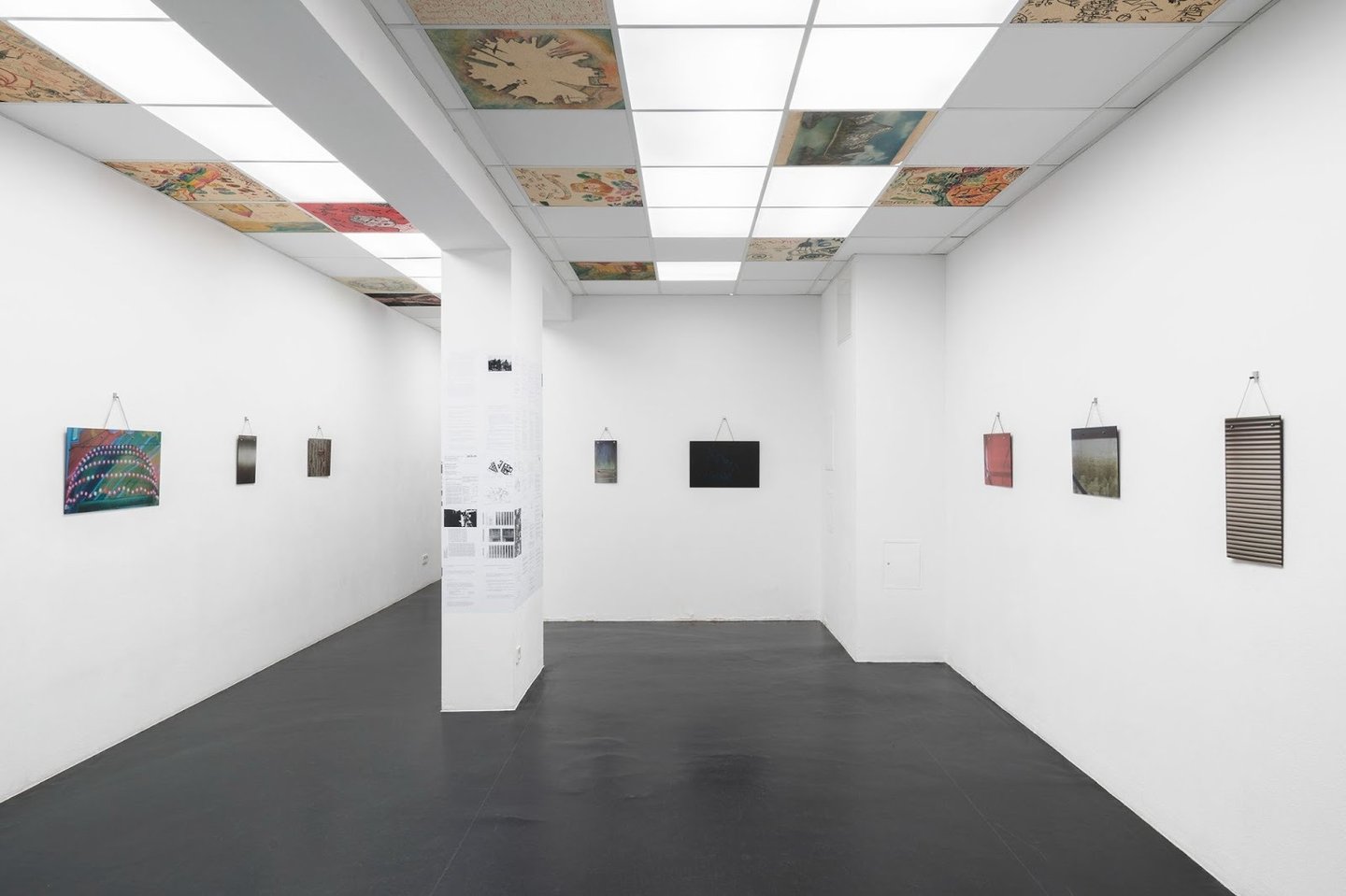
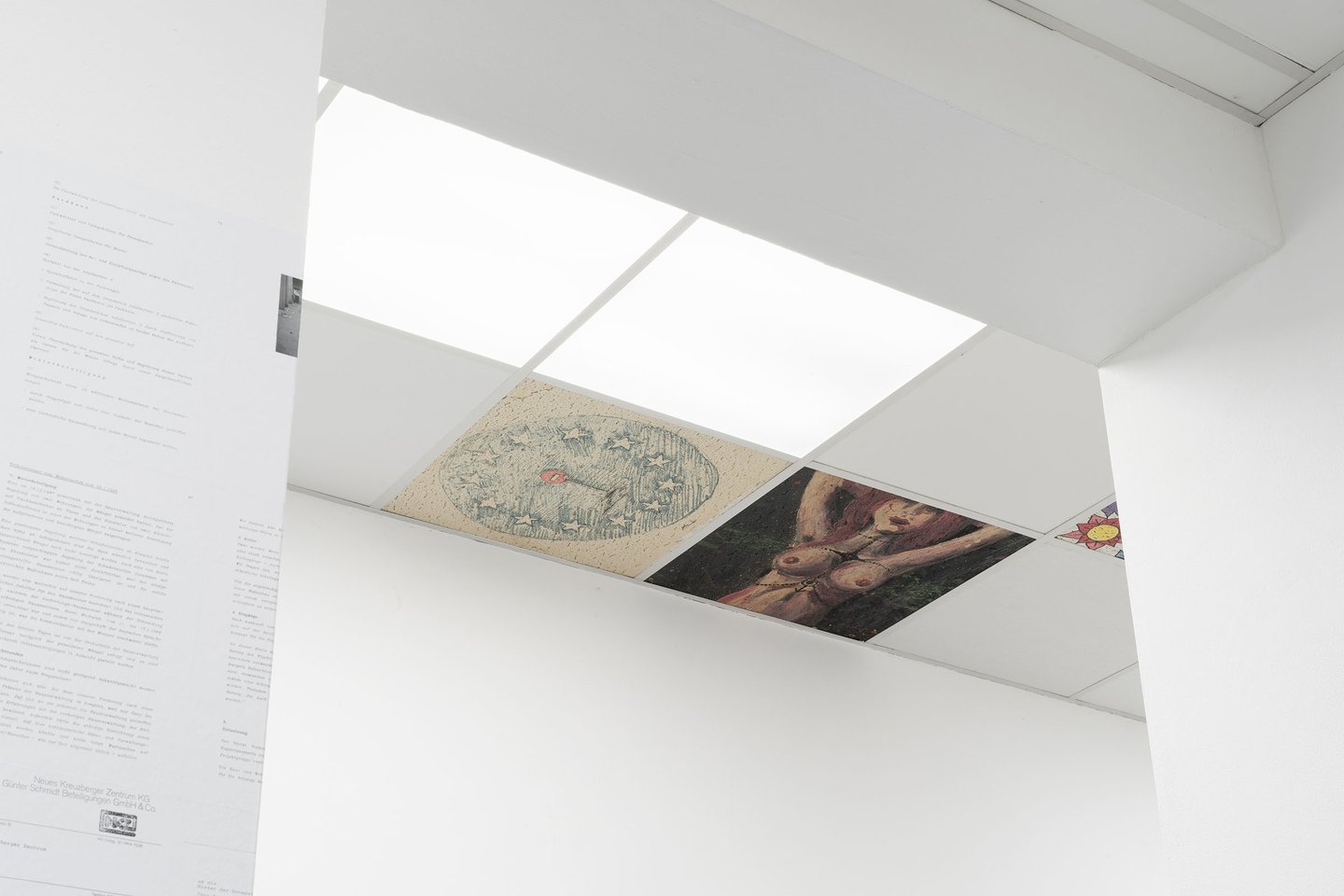
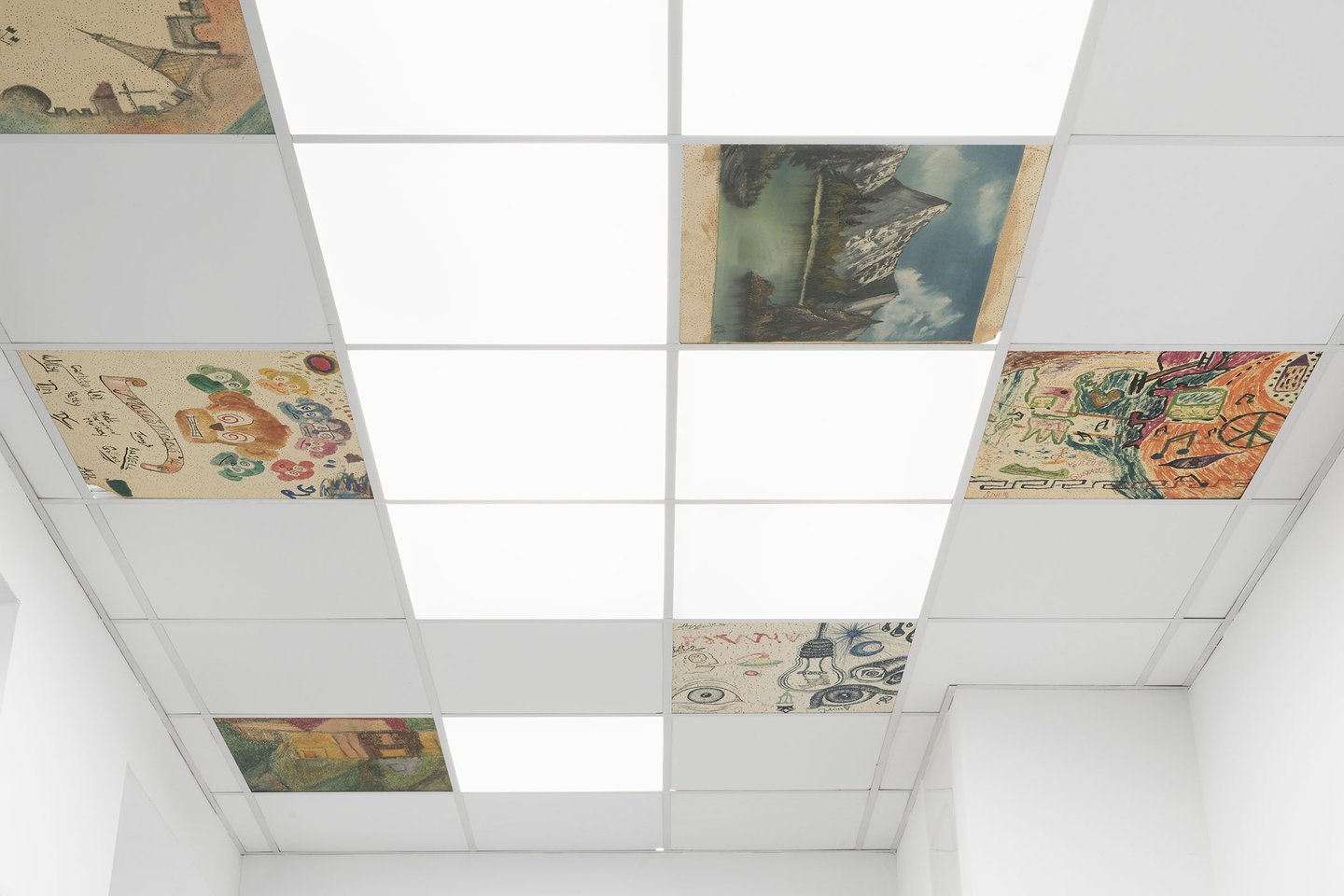
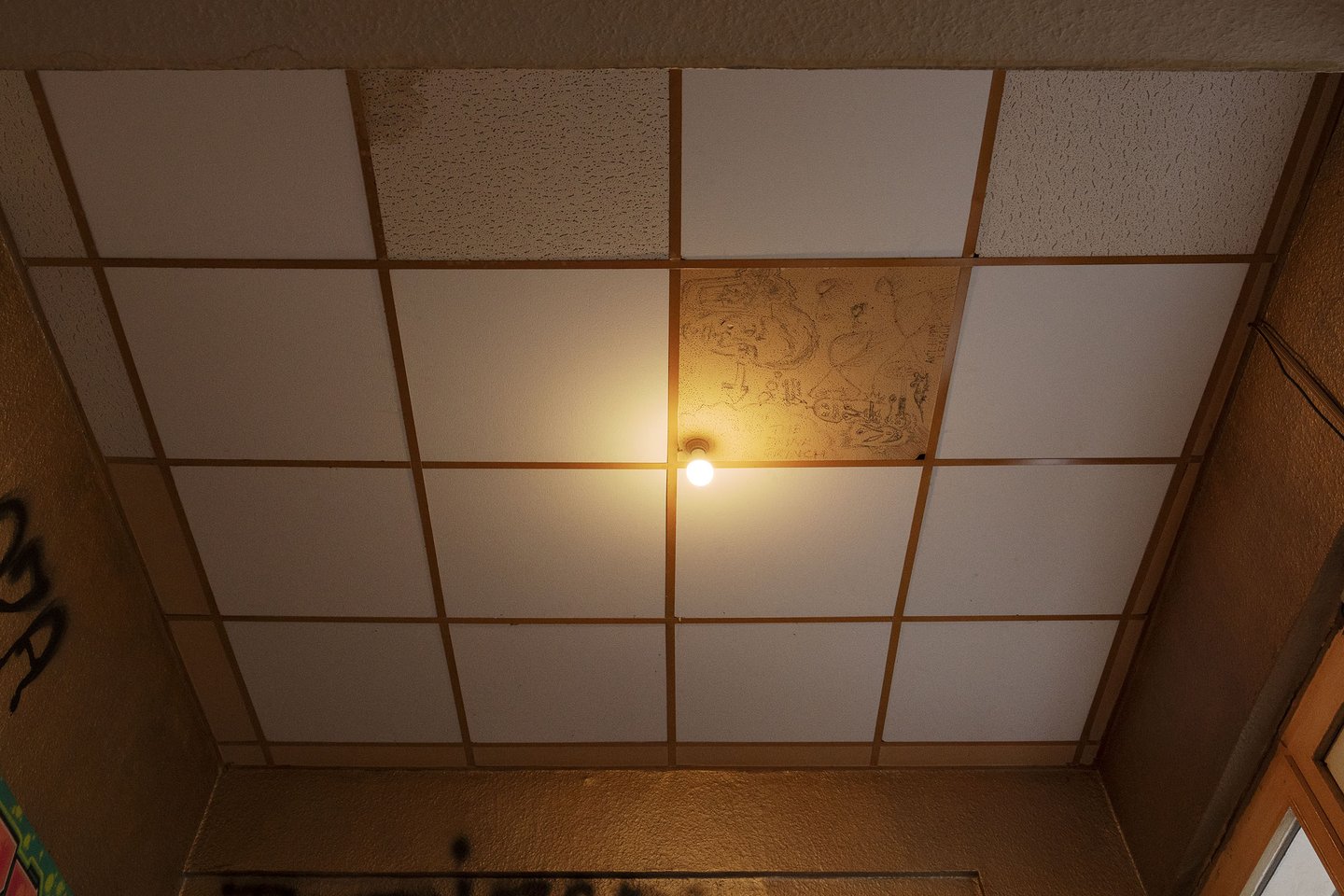
Making a link between its complicated history and the present state of this partly decrepit building, Holtz’ swapping of the ceiling panels between Café Kotti and Stations, seeks to make visible the shifting communities that continue to coexist within this space. Holtz works with artefacts from the building and its history: the installation Macht das Tor auf creates a bridge between different localities within the building – here, the neighbouring Café Kotti and Station’s exhibition space. Café Kotti’s panels, individually painted by guests of the Café and residents of the building, marked by nicotin stains, water damage, and years of wear, bear traces of time specific to the usage at the café. The swapping between Stations and Café Kotti generates both a concrete and symbolic permeability: two spaces begin to overlap, and architecture itself becomes a medium of transference. In the café, the white panels taken from the ceiling of the exhibi- tion space that Holtz inserted as placeholders appear as an inscription “in the other direc- tion”: they mark not only an exchange but also an echo – a trace suggesting that something else is “breathing” here. At Stations, the in- stallation continues along the columns – the piece Ein Zentrum ist das nicht is based on a report about life in the NKZ from the perspective of its residents, it unfolds as a double movement: a retranslation of architecture into lived experience, and a transference of those experiences into artistic form.
In Kathrin Wojtowicz’s work, space appears to be defined by the relation between notions of the self and the outer world as well as by questions of accessibility and availability. For the object series in the exhibition, she printed her photographs on pre-owned wall mirrors. Details of backdrop-like facades, doors, grids and thresholds, closing or impermeable rooms and landscapes, sometimes reflective architectural elements, are depicted onto the surfaces. The shape and size of the objects are reminiscent of packaging or bags as well as reversible signs that communicate the opening times of shops and businesses through door panes into public space.
The concept of mimicry and its facets such as imitation, identification and deception, which Holtz’s installation also touches on, forms a link to Wojtowicz’s work. The imitation of a shape instead of a pattern, an imitation of objects in the sense of “sculpture photography” (Leslie Dick, Voluptuous Panic, Digital Whirlpool, 2022) seems to question the perception of space in which it irritates through illusion. Similarity that is not used for camouflage purposes turns into something exuberant and eclectic. Mimicry is an option for a risky game with attraction, identification and luxury. Wojtowicz translates these latter qualities into images whose carriers – mirrors – serve as signifiers of mimicry, while also functioning as strange supports that amplify the fiction of her images. Mirrors that turn into images, and images that pose as mirrors – they reflect, conceal, and imitate their surroundings, evoking perspectives in which the boundaries between inside and outside, object and environment begin to blur. Seeing itself becomes porous: what is image, what is space, what lies behind? Mimicry less as a strategy of survival or camouflage, and more as a longing for dissolution with the surroundings, but also as a warning.
Like water seeping through, one element flows into another. Between Stations, Schleuse, and Café Kotti, a quiet circulation of material, attention and memory emerges. Within this cycle, the NKZ becomes an allegory of a city working at its own thresholds — “a ruin of its own utopia,” and at the same time, a reservoir for everything it might still become.
Text: Stations
Photos: repro-photo.net
We would like to thank Café Kotti and Friedrichshain-Kreuzberg Museum for their support.
Download Text (Deutsch)
Download text (English)
Download list of works
Anna Holtz is an artist based in Berlin and Vienna. Her work pursues notions of sculpture as spatial constellations that question dualistic concepts of inside and outside. Past work has been presented at makam, Berlin; Schleuse, Vienna; Stations, Berlin; 20 20, Vienna; Sharp Projects, Copenhagen; Galerie der Stadt Schwaz and Academy of Fine Arts Vienna.
Kathrin Wojtowicz is interested in the relationships between social conditions, body politics and media. She lives and works in Vienna. Her work has been shown at Halle für Kunst Lüneburg; Galerie der Stadt Schwaz; The University Gallery of the Angewandte Vienna; Schleuse, Vienna; among others. Film programs for Kunstmuseum and Kunsthalle Bremerhaven, Kunstraum Schwaz, Diagonale/Filmarchiv Austria, mumok cinema.
Invite image: © STERN GmbH, Photo Horst Wiessner, Source FHXB Museum